


For twenty years, the software industry operated on a unified theory of value. We had a standard playbook (T2D3) and a single North Star: Annual Recurring Revenue (ARR).
This standardization was built on a specific reality of the near-zero marginal cost of software. Once code was written, serving the next customer cost pennies. This allowed vendors to offer “unlimited seats” or flat fees, knowing that heavy usage wouldn’t hurt their bottom line.
That era seems to be coming to an end.
In the AI era, software has real physics. Every prompt incurs an inference cost. Relying on traditional ARR to measure an AI business is like driving a Tesla using a road map from 1999.
We don’t necessarily believe in reinventing the concept of recurring revenue, we are evolving it. When every interaction carries a cost, the “all-you-can-eat” subscription naturally breaks. If you stick to flat pricing today, your most engaged customers - the ones running the most prompts - will destroy your gross margins.
To survive this “AI Tax”, revenue must align with cost! But this shift is not only about protecting downside, it is also about unlocking massive upside.
The Floor vs. The Ceiling
Once you uncap your pricing to cover your costs, you inadvertently uncap your potential revenue. You move from a game of Cost Protection to a game of Value Capture.
Subscription: High Floor / Capped Ceiling.
Consumption1: Low Floor / Uncapped Ceiling.
If a customer derives $10M of value from your software but you charge $50/seat, you capture pennies, leaving the vast majority of the value on the table. Consumption models remove the ceiling. Whether you charge for Usage (Inputs, Tokens, Comput) or Outcomes (Outputs, Resolutions, Transactions), the physics are the same: you are trading linear certainty for exponential scale.
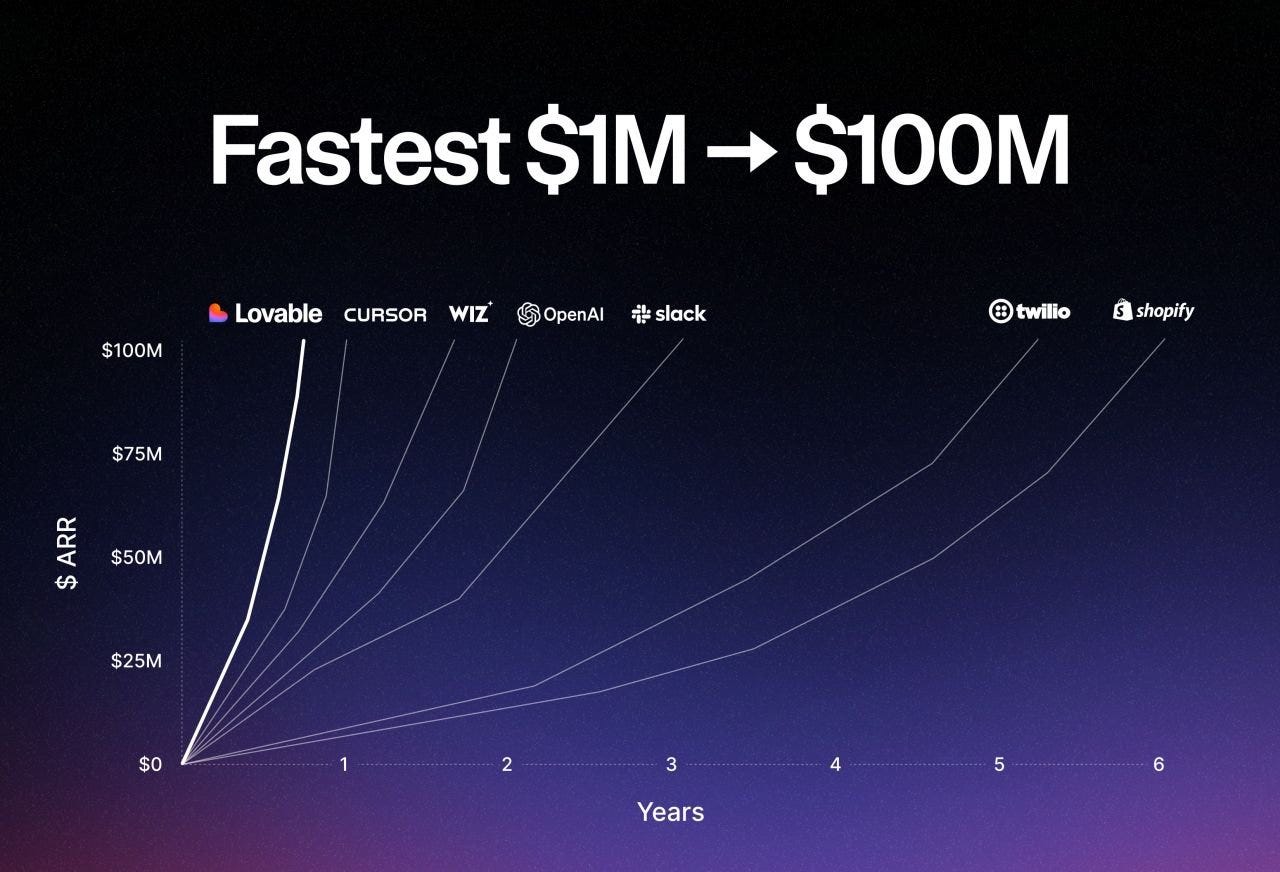
This isn’t just theory! When we look at the defining chart of the AI Era (the fastest companies to reach $100M ARR) a clear pattern emerges. The breakout leaders didn’t get there by selling flat-rate subscriptions. Every single AI player on that list achieved exponential-growth through a consumption-based model.
Consider Riskified2 (NYSE: RSKD). While traditional security software charges for “access,” Riskified charges for Outcomes, as they approve e-commerce transactions. If they approve a fraudulent order, they cover the cost. At the end of the day, they charge for the absence of fraud instead of software, which is the ultimate alignment: they only win when the customer wins.
The New Reporting Standard: Behavior > Formulas
In the subscription era, ARR was a simple formula, while in the Consumption Economy, there is no universal template. Large companies are actively engineering new ways to smooth out the volatility of usage, and it all depends on how their customers behave.
Snowflake3, for example, separates RPO (Bookings/The Promise) from Product Revenue (Consumption/The Reality), creating a critical leading indicator. If RPO grows faster than Revenue, you have “Shelfware Risk” (customers buying but not deploying). If Revenue grows faster than RPO, you have “Burn Risk” (customers consuming backlog too fast - which might be a great opportunity for you CS team!).
Confluent4 breaks out Confluent Cloud (Usage) separately from their legacy Confluent Platform (Subscription). This allows investors to isolate the hyper-growth engine (~30%+ YoY) from the steady-state legacy business. By decoupling them, they prevent the “Capped” business from dragging down the valuation of the “Uncapped” one.
MongoDB5 calculates ARR for their consumption product (Atlas) using a 90-day lookback. This window wasn’t chosen randomly, it was derived from analyzing their specific customer behavior. They recognized that usage fluctuates monthly, so they use a 90-day rolling average to separate signal from noise.
The Metrics Evolution
The traditional SaaS formulas rely on variables that are assumed to be constant (fixed pricing, linear retention). In an AI model, these variables are volatile, rendering the standard equations useless.
So, how do we measure health now?
1. NRR is now The Behavioral Truth In SaaS. Net Revenue Retention was often a Sales Metric, driven by a rep negotiating an upsell or cross-sell.
In AI, NRR is a Behavioral Metric. It acts as the aggregate score for all value delivered, summing up Usage (Inputs) and Outcomes (Outputs), measuring the daily reality of the customer’s life:
Usage: Are they integrating the tool deeper?
Outcome: Are they actually solving the problem?
If the behavior indicates value, the spend expands organically across both vectors. If the behavior stops, the revenue stops.
It’s important to remember that this depends on how your customer uses your product. They might use it on a quarterly basis, which means that you should never look at NRR on a monthly basis!
2. GRR became the anti-whale mechanism. In consumption models, one exponentially growing customer can hide the churn of dozens of others in your NRR.
GRR forces you to face the truth because it strips out this expansion. By capping retention at 100%, it reveals “Shrinkage” - customers reducing usage - without the buffer of your biggest spenders. If you have high NRR but low GRR, you don’t have a broad product-market fit, you have a leaky bucket subsidized by a few big contracts.
3. For Churn, context is king. In the new world, it is a behavioral metric.
If your product is used quarterly (e.g., tax software), a customer with zero usage in July hasn’t churned. You must define churn based on the natural frequency of your user.
4. Realized LTV has replaced Predictive LTV. The standard formula (ARPA*Gross Margin)/Churn fails because it assumes usage is flat.
In AI, usage follows a volatile “J-Curve,” rendering static variables useless. You must replace prediction with history. Instead of guessing future value based on last month’s data, analyze your historical cohorts to answer the only question that matters: “How much cumulative gross profit has this specific cohort actually generated to date?”
Our Take
At SaaSholic, we have always been avid defenders of a standardized SaaS Metrics approach. Unfortunately, in the AI Era, that spreadsheet no longer exists.
We aren’t throwing away the old playbook, but we are rewriting the chapters on what matters. When we evaluate AI businesses today, we look through a new lens:
Contracts are the Floor, Habits are the Ceiling. We still value contracts for downside protection, but “Workflow Stickiness” is the ultimate retention mechanism. A dollar of revenue from a daily habit is worth infinitely more than a dollar from a “shelfware” contract that is destined to churn.
Revenue is Vanity, Contribution is Sanity. While we believe inference costs will continue to drop, we don’t rely on it6. We prefer businesses that have viable unit economics today and will see them supercharged as costs fall, rather than those dependent on future hardware deflation just to become profitable.
This requires a shift in mindset, as you can no longer manage your business by looking at a dashboard of generic SaaS metrics. You must understand the specific physics of your customer’s consumption. We now strongly incentivize our founders to build their metrics stack from first principles, which requires a level of maturity and self-awareness that goes beyond filling in cells in Excel.
We truly believe that the new winners won’t be the companies with the smoothest charts. They will be the ones who accept the volatility of consumption in exchange for the uncapped upside of the value they generate.
We are learning alongside our founders just how challenging this shift can be, and we are seeing a brand new cohort of companies emerge with entirely unique business models, metrics, and pricing. If you are building a business that fits this vision, we’d love to learn more!
This NRR-as-behavior shift is a game-changer!
Pricing AI products with traditional ARR is like navigating with a 1999 roadmap. When every prompt has real cost, flat subscriptions become a margin killer - your most engaged users literally burn your profitability.
The insight that hit hardest: That GRR vs NRR paradox. A few whales masking structural churn is the silent killer nobody talks about until it's too late.
Love the "build from first principles" approach. No more copy-paste SaaS templates. Every AI business has unique consumption physics.
Quick one: which verticals in your portfolio are showing the most mature consumption models? Curious to see this playing out in the wild.
Bookmarked! 🚀
Excellent framing. The shift from NRR as a sales metric to NRR as a behavioral metric is the most underrated insight here.
The implication: retention stops being a CS conversation and becomes a product and architecture conversation.
If NRR reflects daily habits and workflow stickiness, the question isn't "how do we upsell" but "are we building the kind of dependency that makes reducing usage painful?"
That's a fundamentally different retention system than what most CS teams are running today.